- The Looney Blog
- Posts
- Why Presenting Films In the Incorrect Aspect Ratio is a Terrible Idea
Why Presenting Films In the Incorrect Aspect Ratio is a Terrible Idea

Jonathan Adair
March 14, 2026
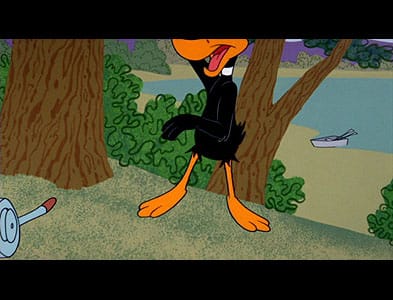
“The Million Hare” (April 6, 1963) as seen on the Looney Tunes Super Stars Bugs Bunny Hare Extraordinaire DVD (2010). The cartoon was one of several cropped to widescreen on the first two Super Stars DVDs, and as a result, the picture is missing SO much.
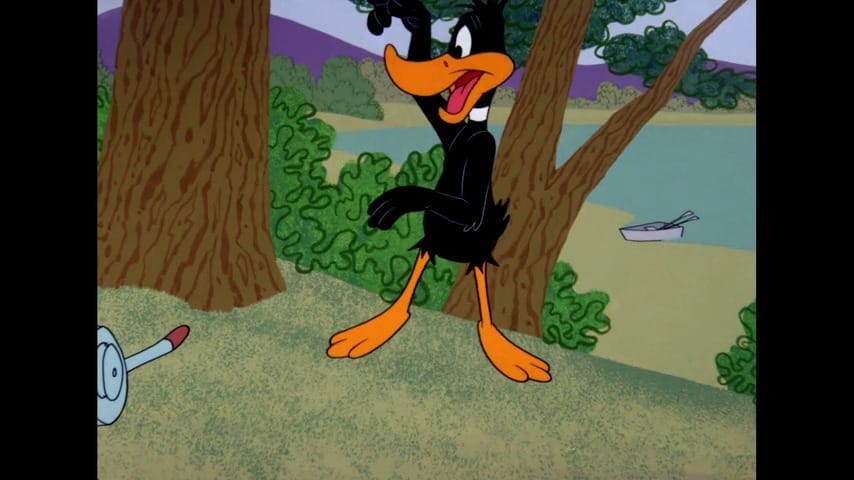
The exact same image from the cartoon in its correct aspect ratio as seen on the Bugs Bunny 80th Anniversary Collection Blu-ray (2020). MUCH better!
Since we are now at the point where widescreen became a new thing, today I am going to talk to you about the problems it can cause.
Why Is This an Issue?:
Up until 1954, every theatrical cartoon from each studio had been shown in full frame. While a few of the studios that year started producing some cartoons in the widescreen format known as “CinemaScope” (MGM in particular, as noted below), Warner Bros. never used it as none of their cartoons were ever intended for widescreen. However, it’s been said that a few theaters had shown them that way, and as a result, there was some misinformation about how they are supposed to be presented.
The Unnecessary Widescreen Cropping on Looney Tunes Super Stars:
Nearly two years after the wonderful Looney Tunes Golden Collection DVD series ended with Volume 6 in 2008, Warner Home Video launched a new line called the Looney Tunes Super Stars. These sets are single-disc character-centered compilations with some of the most attractive box art seen on any of the Looney Tunes home media releases. While they appear to be bare-bone budget releases due to them having only one disc with just cartoons and no bonus features, these releases are nevertheless worth collecting because most of the time, they feature newly restored cartoons that had not been seen on any release prior (the sole exception is Tweety and Sylvester Feline Fwenzy as it contains only cartoons that had already been released in the Golden Collections). On August 10, 2010, the first two were released with those being Bugs Bunny Hare Extraordinaire and Daffy Duck Frustrated Fowl. Both of these could have EASILY been five-star releases since they both include 15 cartoons in stunning new restorations, none of which appeared on any of the Golden Collections. Unfortunately, there was a huge mistake that plagued both sets: all of the post-1953 cartoons on both sets were incorrectly cropped to widescreen as a result of misinterpretation of how the cartoons were presented in their original theatrical releases. Since these cartoons were never intended for widescreen, a lot of the picture on the twenty cartoons affected were gone. Floors and feet were missing, characters’ heads would leave the frame when they were merely standing upright, and a few visual gags were also cut off. Many fans were livid about this as angry calls were made and extremely negative reviews were left on the respective Amazon pages. The two sets, though, are still worth collecting for all of the pre-1954 cartoons, which ARE presented properly. Fortunately, all of these cartoons have been presented in full frame on streaming platforms and on subsequent releases, making it clear that Warner Bros. realized the cropping was a mistake. The next three Super Stars releases that contained cartoons entirely new to disc in restored form, Foghorn Leghorn and Friends Barnyard Bigmouth (November 30, 2010), Roadrunner and Wile E. Coyote Supergenius Hijinks (October 4, 2011), and Pepe Le Pew Zee Best of Zee Best (December 27, 2011), all feature an option for people viewing to watch them in either full frame or widescreen. While the widescreen option was clearly unnecessary, the fact that the cartoons could still be watched in their correct aspect ratio was nevertheless a sigh of relief to everyone. Even better, on the final two Super Stars releases, Porky and Friends Hilarious Ham (November 6, 2012) and Sylvester and Hippety Hopper Marsupial Mayhem (April 23, 2013), neither set has a widescreen option at all, indicating that Warner had finally, officially realized these cartoons were intended for full frame.
What Cartoons Were Affected and Where Can One View Them in Full Frame?:
If there was any silver lining to the cropping issue, it’s the fact that all of these cartoons had in fact been restored in full frame (Jerry Beck did mention he had tried to talk Warner Home Video out of the widescreen idea, but his pleas fell on deaf ears. Proof that you need someone like Beck ,who, like me, actually knows a lot about cartoons, to be in charge of these releases). These cartoons would appear in full frame on the now defunct Boomerang streaming app (2017-2024) and later on HBO Max in 2020. Noted below on both releases are the cartoons that were cropped and where you can find them in their proper aspect ratios:
Bugs Bunny Hare Extraordinaire (2010):
Lumber Jack Rabbit (1954)- fixed on Bugs Bunny 80th Anniversary Collection (2020)
Napoleon Bunny Part (1956)- fixed on Bugs Bunny 80th Anniversary Collection (2020)
Bedevilled Rabbit (1957)- fixed on Looney Tunes Platinum Collection Volume 1 (2011)
Apes of Wrath (1959)- full frame version currently not on disc, but is available to stream on Tubi
From Hare to Heir (1960)- fixed on Bugs Bunny 80th Anniversary Collection (2020)
Lighter than Hare (1960)- fixed on Looney Tunes Collector’s Choice Volume 4 (2024)
The Million Hare (1963)- fixed on Bugs Bunny 80th Anniversary Collection (2020)
Mad As a Mars Hare (1963)- fixed on Looney Tunes Platinum Collection Volume 1 (2011)
Dr. Devil and Mr. Hare (1964)- fixed on Looney Tunes Platinum Collection Volume 1 (2011)
False Hare (1964)- fixed on Bugs Bunny 80th Anniversary Collection (2020)
Daffy Duck Frustrated Fowl (2010):
Design for Leaving (1954)- full frame version currently not on disc, but is available to stream on Tubi (side note: this cartoon will actually be Monday’s cartoon, which is what gave me the idea to do this post)
Stork Naked (1955)- fixed on Looney Tunes Collector’s Choice Volume 4 (2024)
This Is a Life (1955)- fixed on Bugs Bunny 80th Anniversary Collection (2020)
Dime to Retire (1955)- full frame version currently not on disc, but is available to stream on Tubi
Ducking the Devil (1957)- fixed on Looney Tunes Platinum Collection Volume 1 (2011)
People are Bunny (1959)- fixed on Bugs Bunny 80th Anniversary Collection (2020)
Person to Bunny (1960)- fixed on Bugs Bunny 80th Anniversary Collection (2020)
Daffy’s Inn Trouble (1961)- full frame version currently not on disc, but is available to stream on Tubi
The Iceman Ducketh (1964)- full frame version currently not on disc, but is available to stream on Tubi
Suppressed Duck (1965)- full frame version currently not on disc, but is available to stream on Tubi
CinemaScope at MGM and Its Aspect Ratio Issues:
As mentioned above, MGM is the studio that used CinemaScope the most. A good number of their cartoons from 1954 and 1955 were filmed this way, but from 1956-1958, all of their cartoons were in CinemaScope. Believe it or not, but there was even some issues with THAT, as several places had incorrectly showed these cartoons in full frame, resulting in most of the picture being gone and making these hard to watch as a result. On home media releases aimed at collectors, they are restored and fortunately, in their correct aspect ratio (most notably on the Tom and Jerry The Complete CinemaScope Collection Blu-ray set, released a little over a year ago in February 2025, which were all subsequently put on the Tom and Jerry Golden Era Anthology Blu-ray set this past December). Seen below is a comparison of the 1957 Tom and Jerry cartoon, “Mucho Mouse” in its proper widescreen presentation and then in an improper full frame version.
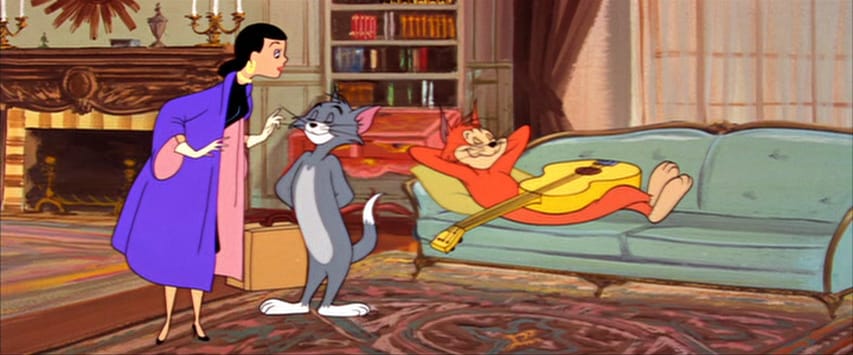
How a CinemaScope MGM cartoon should be seen

How a CinemaScope MGM cartoon should NOT be seen. Again, you are missing SO much!
There Is an Exception, However:
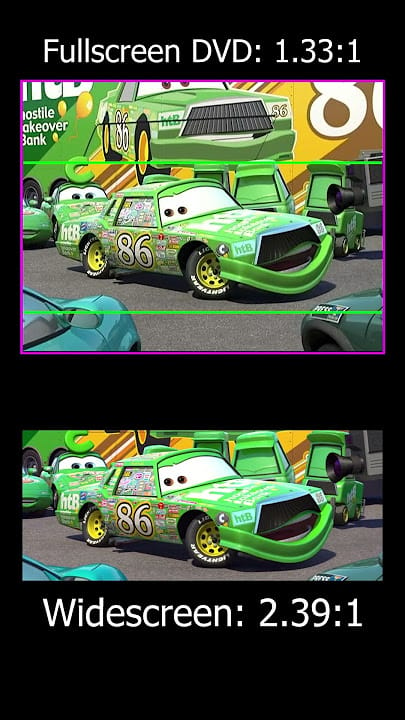
As you can see, the widescreen version of “Cars” is also missing a lot of picture.
One of Pixar’s greatest films, “Cars” (2006) was originally released in theaters in widescreen. However, when it was released to DVD in November 2006 (coincidentally, a whole week before Looney Tunes Golden Collection Volume 4 came out that year on November 14), it was presented in full frame, which showed a lot more of the image (and that is indeed the version of the movie I’ve owned since I got it as a Christmas present in 2007 when I was a little boy and I still own it to this day). This was also pointed out by the YouTube channel, “The Unlucky Tug” (who is mostly known for his fantastic content talking about “Thomas the Tank Engine and Friends” as he pretty much knows everything about that franchise) in one of his non-Thomas videos, which talks about the Cars franchise. At the end of his section on the first movie, he talks about why he used the full frame DVD for the video footage rather than the HD version seen on Disney+ and elsewhere. His answer is, “Because the widescreen version of ‘Cars’ is missing SO MUCH!”, and makes some comparisons as proof. I couldn't agree more, as I prefer watching the movie in full frame and is the only instance where viewing it as it wasn’t originally presented is preferable.